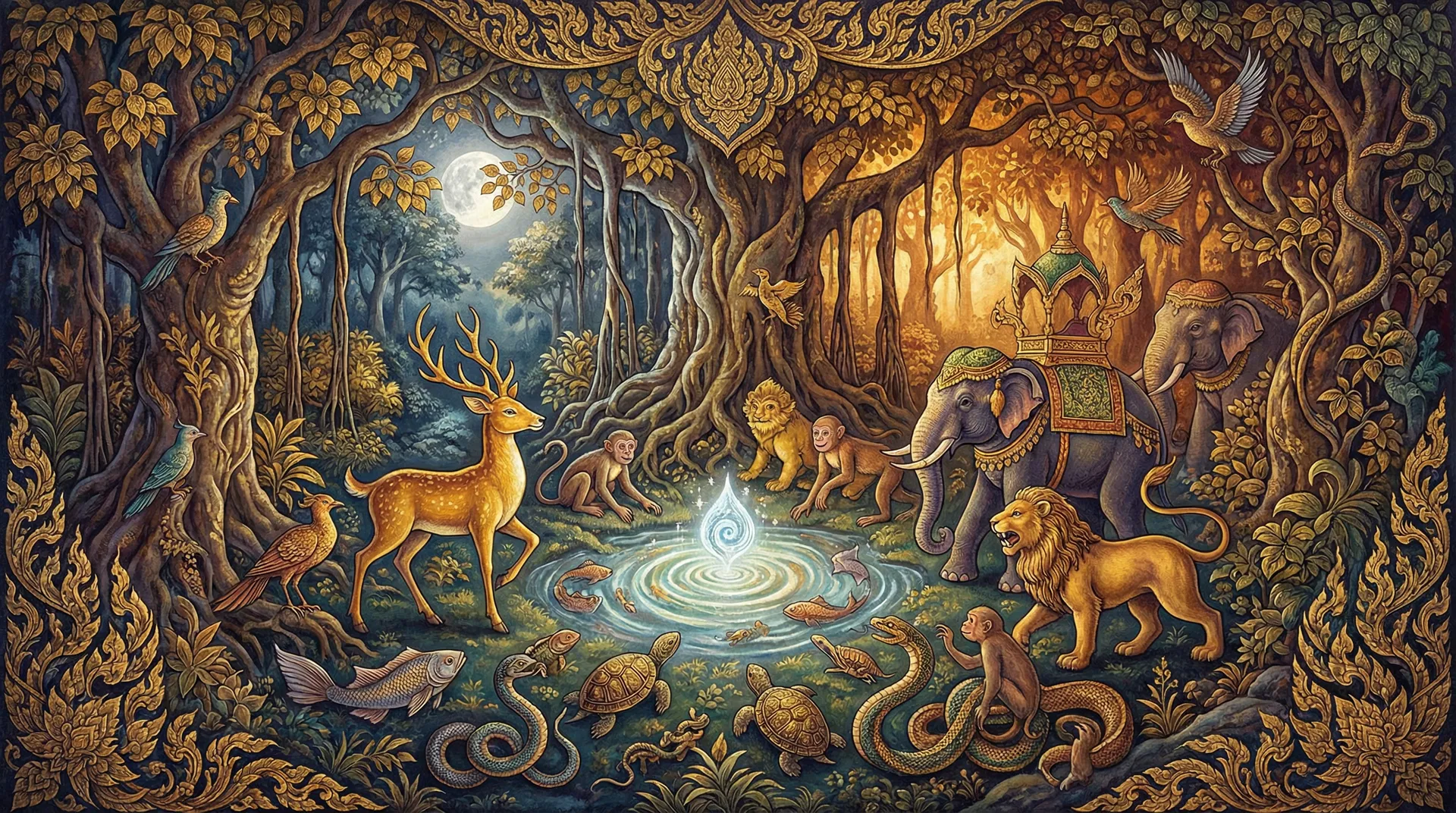
Kusa Jātaka
The Tale of Prince Kusa and the Golden Wheel
In the opulent kingdom of Videha, ruled a king whose heart was as vast as his domain. He had a son, Prince Kusa, whose beauty was said to rival the moon and whose charm captivated all who met him. Yet, despite his royal upbringing and the adoration of his people, Kusa harbored a deep sadness. His father, the king, was a man of strange customs. He believed that to ensure the prosperity of the kingdom, he must offer his son’s wife to the gods every seven years. This dark prophecy cast a long shadow over the prince’s life.
When Kusa came of age, he was married to the beautiful Princess Pabhavati. Their love was pure and deep, and the thought of her being sacrificed filled Kusa with anguish. He vowed to protect her at all costs, even if it meant defying the ancient, cruel decree.
On the eve of the ritual, as the kingdom prepared for what they believed was a sacred duty, Kusa made a daring plan. He couldn’t bear to see his beloved Pabhavati suffer. He approached his father, his voice trembling with emotion.
“Father,” he implored, “I cannot let Pabhavati be offered. My love for her is greater than any decree. I will find a way to appease the gods without her sacrifice.”
The king, bound by tradition and fear, could only shake his head. “My son, this is the law. It has been so for generations. To defy it is to invite ruin upon us all.”
Desperate, Kusa sought the counsel of the wisest sages in the kingdom. They, too, were bound by the traditions but saw the genuine love in the prince’s eyes. One sage, a man who had dedicated his life to understanding the cycles of the cosmos, offered a glimmer of hope. “There is a legend,” he whispered, “of a celestial wheel, the Kusa-cakka, a golden disc that holds immense power. It is said to be guarded by celestial beings in the heavens. If one can obtain it, it can appease any divine wrath and avert any calamity.”
Driven by love and determination, Prince Kusa embarked on a perilous journey. He left his palace, his comforts, and his beloved princess, venturing into the unknown. He traversed treacherous mountains, navigated dense jungles, and crossed vast deserts, facing trials that would break the spirit of any ordinary man. He encountered fearsome beasts, cunning demons, and faced the biting winds of the Himalayas, his resolve unwavering.
During his arduous quest, he met an old hermit who, seeing the prince’s noble purpose, taught him ancient chants and rituals that would aid him in his ascent to the heavens. The hermit explained that the Kusa-cakka was not merely a physical object but a symbol of pure intention and unwavering devotion. The journey itself was a purification, a test of his resolve.
Finally, after years of hardship, Kusa reached the celestial realms. There, he faced the guardians of the Kusa-cakka. They tested him not with brute force, but with riddles and moral dilemmas, challenging his worthiness. Kusa, drawing upon his innate wisdom and the lessons learned from his journey, answered each challenge with honesty and courage. He spoke of his selfless love for Pabhavati, his desire to protect his kingdom, and his commitment to truth.
Impressed by his purity of heart and the strength of his devotion, the celestial guardians granted him the Kusa-cakka. It shone with an ethereal light, radiating warmth and power. With the golden wheel in his possession, Kusa returned to Videha. The people rejoiced at his safe return, but their joy was tinged with apprehension about the impending ritual.
As the day arrived, Kusa stood before his father, the priests, and the anxious populace, holding the Kusa-cakka aloft. He explained the celestial wheel’s power and how it would serve as an eternal safeguard for the kingdom, rendering the human sacrifice obsolete. He performed the sacred rituals, his voice resonant with the authority granted by the heavens. The golden wheel pulsed with light, and a palpable sense of peace descended upon the land. The gods, it seemed, were appeased.
From that day forward, the kingdom of Videha was blessed with an era of unprecedented peace and prosperity. The cruel decree was abolished, and Prince Kusa and Princess Pabhavati lived a long and happy life together, their love story becoming a legend, a testament to the power of courage, perseverance, and the unwavering strength of true love that could even move the heavens.
— In-Article Ad —
💡Moral of the Story
True love and unwavering devotion can overcome even the most deeply entrenched traditions and fears. Courage and perseverance in a noble cause can lead to extraordinary achievements.
Perfection: Generosity (Dāna Paramī)
— Ad Space (728x90) —
More Jataka Tales You May Enjoy
 294Tikanipāta
Sambhava Jātaka
The Tale of the Bodhisatta's ReturnIn the verdant kingdom of Sāketā, a wise and just king named Mahā...
💡 True renunciation is not about escaping one's responsibilities, but about fulfilling them with detachment and using one's position to benefit others. The legacy of a virtuous life is seen in the actions of those who follow.
 120Ekanipāta
Sibi Jataka
Sibi Jataka In the ancient kingdom of Sibi, nestled amidst fertile plains and blessed with bountiful...
💡 The highest form of compassion and truthfulness involves selfless sacrifice for the well-being of others. True virtue transcends natural laws and personal comfort, earning immeasurable merit and inspiring all.
 156Dukanipāta
Dhopa Jataka
Dhopa JatakaIn the ancient kingdom of Mithila, renowned for its flourishing arts and discerning popu...
💡 Do not be fooled by superficial allurements and intoxicating fragrances; seek that which is pure, genuine, and lasting.
269TikanipātaKacchapa Jataka
Kacchapa JatakaIn the ancient kingdom of Savatthi, nestled amidst rolling hills and fertile plains, ...
💡 True peace and contentment arise from accepting the impermanence of all things and acting with diligence but without attachment to outcomes.
77EkanipātaThe Tale of the Water-Pot Elephant
The Tale of the Water-Pot Elephant In the ancient city of Varanasi, nestled beside the sacred Gange...
💡 The ultimate offering is the selfless sacrifice of one's life for others, driven by genuine compassion, capable of bringing about complete restoration and healing.
239DukanipātaNimi Jataka
Nimi JatakaIn the flourishing kingdom of Mithila, ruled a king named Nimi, whose reign was character...
💡 All worldly pleasures, even those in celestial realms, are impermanent and subject to the law of karma. True liberation comes from understanding and transcending the cycle of birth and death through virtuous living.
— Multiplex Ad —